Prices checked in November 2026. Where a figure has a source, I've named it and dated it. Where I did the arithmetic myself, I've said so in the sentence — but I'm a renter with a calculator, not a contractor, so treat my numbers as ballpark.
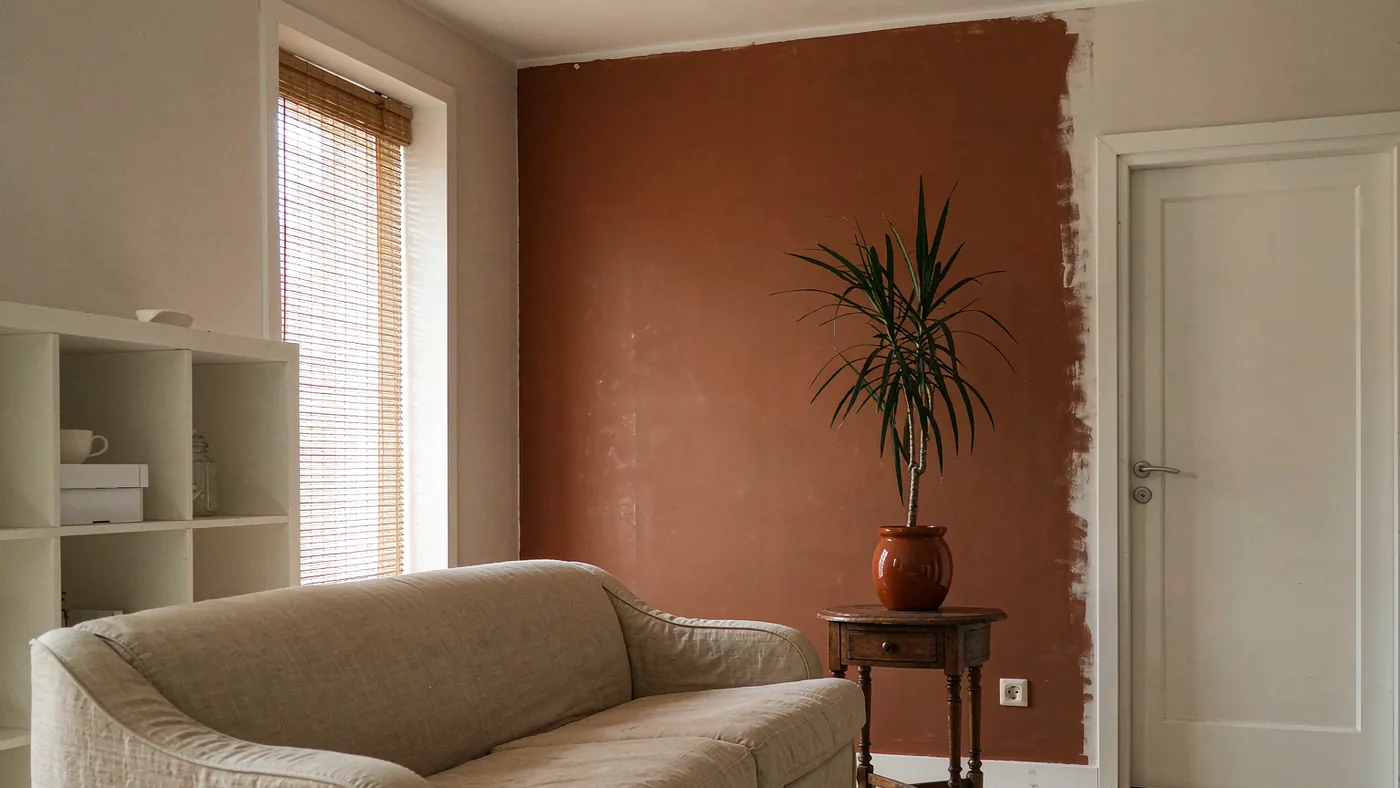
One wall. White ceiling. That's the compromise.
The 2026 version of “make a room feel bigger” asks you to paint the ceiling, baseboards, doors and window frames the same color as the walls. I read the articles, then I read my lease: no painting, no drilling, no permanent changes, and a $1,200 deposit. I spent a weekend pricing removable ways to get close (the same no-drill logic I used for my rental bathroom storage setup). What follows is half spreadsheet, half me arguing with myself. My cat Olive is asleep against the one wall that gets afternoon light, which is probably where any test patch would have to go.
The trend, and why I'm not sure it's mine
Color drenching means one color on the walls, ceiling, trim and doors. Zillow’s 2026 listing data, which I checked in November 2026, has listings mentioning the term up +149% year over year. I checked it twice; undated versions keep resurfacing.
The colors are specific. Houzz’s summer 2026 trend report logged rust and orange searches up +178% and chocolate brown up +153%. I see the same instinct in my building — terracotta pots, dark wood, just smaller.
Here’s the part that snags me. I rent in a mid-size Midwestern city, in a one-bedroom I took because my work contracts run year to year and I didn’t want to buy something I might have to leave. My living room is 10 × 12 ft (3 × 3.7 m). I’m the target demographic for the small-room trend and also the person who can’t touch a single surface in it. Rooms are shrinking generally — the NAHB series has average new home size at 2,411 sq ft, down from 2,479, a 13-year low — so I seem to be living in the small-room future with none of the owner’s freedom to fix it.
What the homeowner version actually does
Color drenching works by deleting corners. When wall, ceiling, crown, baseboard and door casing share one color, the eye stops reading where one surface ends and the next begins. An accent wall does the opposite: it moves the break inward and turns up the volume on it. I could paint one wall rust and still have a white ceiling and white trim outlining it like a frame.
I priced the real thing anyway, to see if it was as unreasonable as it felt. My room has 352 sq ft of wall gross; the door and window take off about 36, leaving roughly 316, and the ceiling adds another 120. Two coats over builder white is somewhere near 872 sq ft of coating, which at 350 sq ft a gallon means three gallons. With rollers, tape and drop cloths, I make that $190–$235 in materials (November 2026 prices), doors and trim not included. For scale, Angi’s 2026 cost data puts average cabinet installation at $6,191 across 5,122 projects — built-in color belongs to that bracket, and I don’t live in it.
My lease requires written approval for paint. Zillow’s 2026 Renter Report puts 35% of US households in rentals, median renter age 41, and 23% having moved in the past year. I’m one of that 23%: I moved in back in March and I genuinely don’t know if I’ll be here next March. A few hundred dollars of paint and a weekend don’t pay back over twelve months. The homeowner version assumes a decade of use; mine assumes a renewal I don’t control. I might be wrong about moving — people say that and then stay five years — but I’m not going to plan a paint job around a maybe.
Four things I can take down when I move
Peel-and-stick wallpaper, on one wall. The rolls I looked at in November 2026 are 24 in (61 cm) wide and 27 ft (8.2 m) long, and after matching and trimming I get about 30 sq ft usable per roll — rough, because it depends entirely on the pattern. Mid-range brands ran $32 to $55; I used $45. The catch, and I keep circling back to it, is my walls: a light orange-peel finish that the adhesive grips instead of the paint, so pulling it off with a hairdryer can take paint with it. A woman on the floor above had exactly that happen in her last apartment. She showed me the spot, and I still wonder whether it was the paper or the paint underneath that failed. Directional prints seam across a 10 ft wall, so solid or small non-directional is the only sensible choice. It’s the option I want most and trust least.
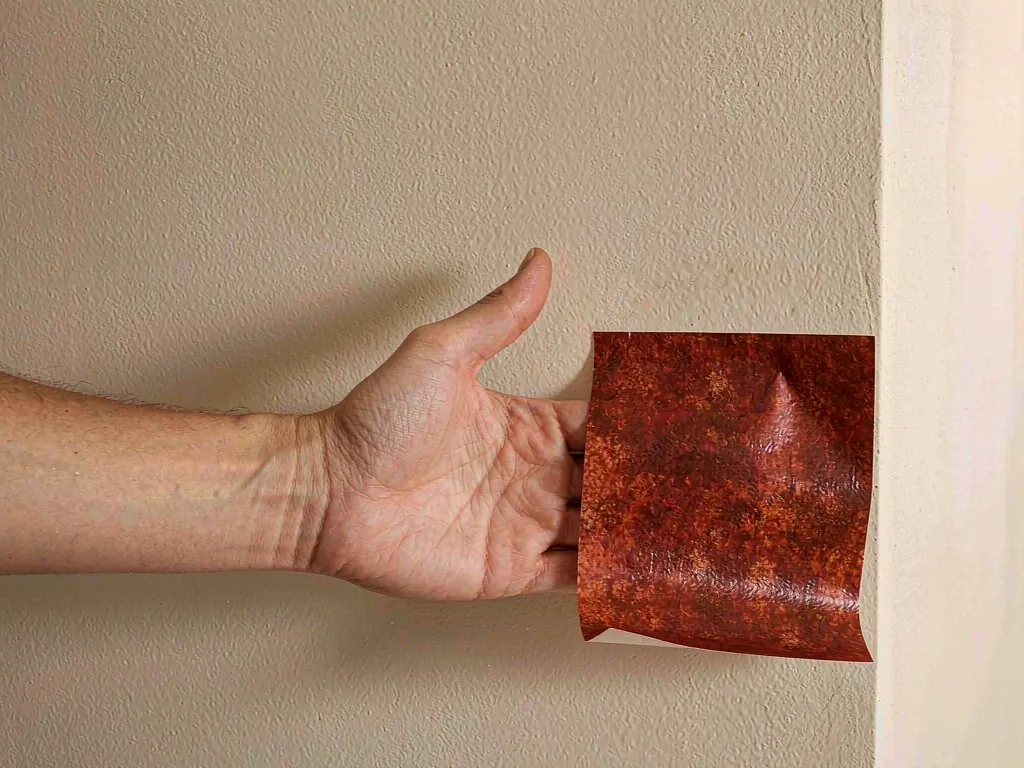
The test patch before the commitment.
Tension-mounted fabric panels. My cat Olive would have these down in a week. That’s before we even get to each strip holding about a pound, so no leaning on them, and to the white corner still showing behind the fabric. Four foam-core panels at $6 each, fabric at $8 to $12 a yard and an $8 pack of removable strips: about $90 and two hours of hanging. I can picture them. I can’t picture them lasting.
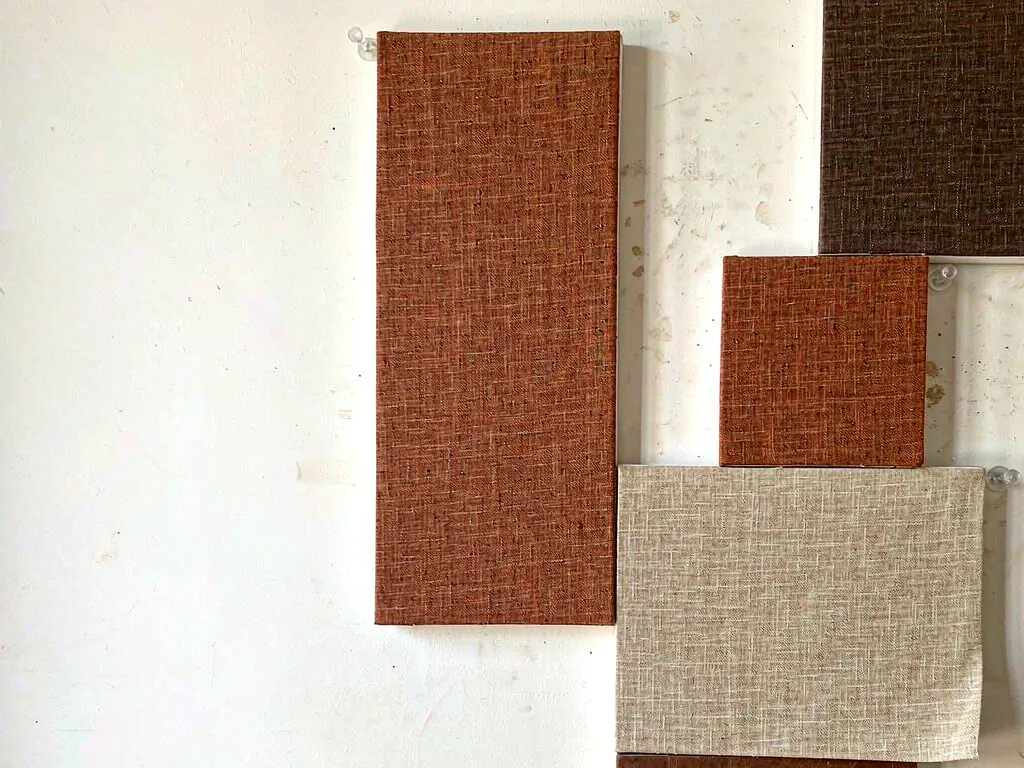
Panels, not drenching — and they don't last.
Paint the furniture, not the walls. I found a used side table for $40 and put $15 of chalk paint on it in about ninety minutes — maybe 12 sq ft of surface against the room’s 436. It’s the only rust-brown thing in the room now, which is either a start or a tease. On laminate the edges chip. On fabric the weave goes stiff. It leaves with me when I go, and there’s no deposit conversation to have.
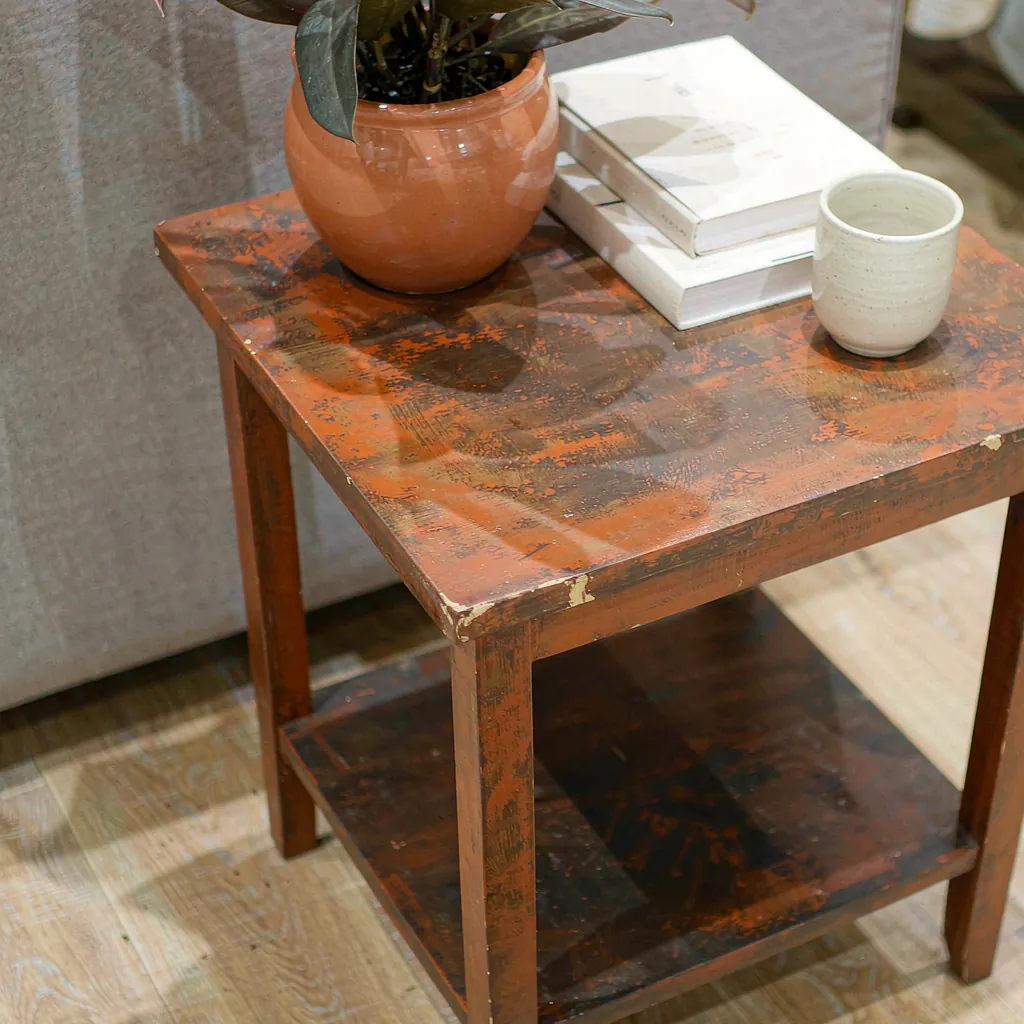
The only thing I'm allowed to paint.
Art and textiles, with nothing stuck to the wall. A stretched canvas at $55, two pillow covers at $30 and a small removable ceiling decal at $25 came to $110, hung in under forty-five minutes with picture strips. Nothing to peel off my wall, nothing to explain to my landlord — which, given the orange-peel situation, is the first option I’d actually try. But a canvas isn’t a drenched wall, and the ceiling stays white outside that one patch. So what, exactly, have I drenched? I know the answer. I just don’t like it.
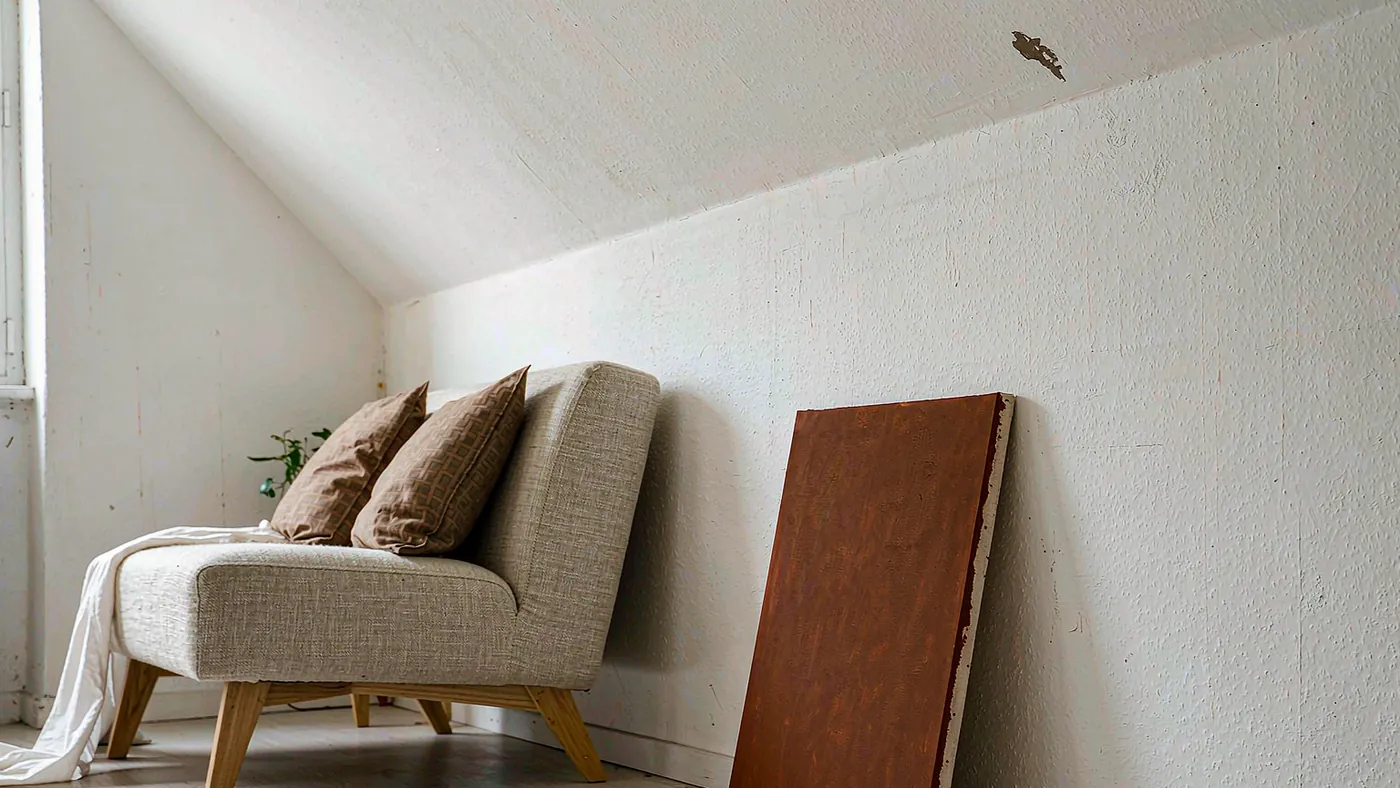
Color with nothing stuck to the wall — almost.
The one wall I'd actually do
My test wall is 10 × 8 ft (3 × 2.4 m) — 80 sq ft (7.4 m²). At roughly 30 usable feet per roll, 80 ÷ 30 = 2.67, so three rolls, not two. Three at $45 is $135, plus a $12 kit of smoother, knife and ruler: $147. With a second person, three hours; alone, longer. I’ve learned not to plan on help that hasn’t confirmed.
The whole room doesn’t scale. 436 sq ft ÷ 30 is 14.5, so 15 rolls at $45 is $675. Paint is $190–$235 in materials and twelve to sixteen hours if I include trim, with the $1,200 deposit sitting under the whole job.
| Option | Surface covered | Cost | My time estimate |
|---|---|---|---|
| One wall, removable paper | 80 sq ft (7.4 m²) | $147 with tools | 3 hours |
| Whole room, removable paper | 436 sq ft (40.5 m²) | $675 | 15+ hours |
| Whole room, paint | 436 sq ft (40.5 m²) | $190–$235 materials | 12–16 hours |
I ran them twice because I didn’t trust the first pass. They didn’t change, but I felt better. The middle row keeps tempting me, though. I keep having to remind myself I don’t own the walls.
Things I've ruled out
- Painting the walls. Materials $190–$235, twelve to sixteen hours, and another $40 to $80 to repaint at move-out. That 23% figure from above is the whole reason: a twelve-month stay doesn't repay it.
- Permanent wallpaper. 15 rolls at $45 is $675, and if it strips the drywall face when I leave I'm looking at $150 to $400 in repair. It stays put when I go, which is precisely the problem.
- Calling one accent wall "drenching." 80 of 436 sq ft is 18% of the paintable surface. The other 82% still stops at a white corner. Words don't change that.
- Full-room removable kits. Quoted at $600 to $900 when I checked in November 2026 — a third to a half of my $1,800 rent, for a look I might get one year of.
- A full-ceiling decal. 120 sq ft at the $25-per-12-sq-ft rate means ten of them, $250, with a seam at every join. I'd rather have the one small patch. Or none.
The part I keep coming back to
Zillow/StreetEasy reported in August 2026 that 49.7% of renters are cost-burdened, and that among families with kids who rent — roughly a third of families with kids — 54.1% are cost-burdened. I’m inside that 49.7%. My rent is $1,800 a month and my deposit $1,200, so $675 isn’t a rounding error; it’s most of a deposit.
My cap is $150 for the whole thing — a little over a tenth of the deposit, under a tenth of a month’s rent. The $147 wall fits and nothing else does. Before it goes up, I’ll stick a 12 × 12 in test patch inside the closet, wait 48 hours, then pull it with a hairdryer and look at the paint underneath. $5 of paper for information no review can give me.
If it lifts paint, I’m out $135 and a Saturday, facing $150 to $400 in drywall touch-ups — which is why the patch comes first. So here’s where I’ve landed: one 80 sq ft wall (7.4 m²), a solid rust or chocolate brown — Houzz’s summer 2026 numbers are the reason — $147, with the receipt and the leftover roll kept. Read the lease before anything touches the wall. It isn’t color drenching. It’s the part of color drenching a renter can afford to get wrong.
If you want more renter-friendly ideas that leave zero damage, I wrote up what actually works in a tiny rental bathroom — same lease, same deposit, same refusal to drill a single hole.
1 thought on “Color Drenching Is 2026’s Biggest Paint Trend. Renters Can’t Paint. Here’s What Actually Transfers.”